The outrageous eviction has sparked the largest protests the country has seen in 15 years

Maricarmen was an 87-year-old resident of Madrid’s central Salamanca district. After living as a tenant in the same home for 70 years — the house where her parents had also lived until the end of their lives — she was evicted on September 23. Her home was bought by a vulture fund in 2018, which decided to “bring the rent in line with market prices.” Maricarmen, who received a €1,300 monthly pension, was told that her rent would increase from €500 to €2,600 overnight, and that if she could not afford it, she should leave. That was when her fight began: a pensioner against a vulture fund that operates in the Spanish capital.
After years of fighting and four eviction attempts, successfully halted by the Madrid Tenants’ Union, Maricarmen was finally removed from her home. Police officers had to drag away protesters who were trying to prevent the eviction, break down the door and carry her out on a stretcher because she was too weak to walk. The images sparked outrage across the country, as people rallied around Maricarmen and identified with her vulnerability in the face of Spain’s unaffordable housing market. After spending two weeks in hospital due to the stress caused by the eviction, Maricarmen died. In interviews, she had said that all she wanted was to spend her final days in her home, just as her parents had done before her. She was not allowed to. Maricarmen died on the same stretcher on which she had been carried out of her home.
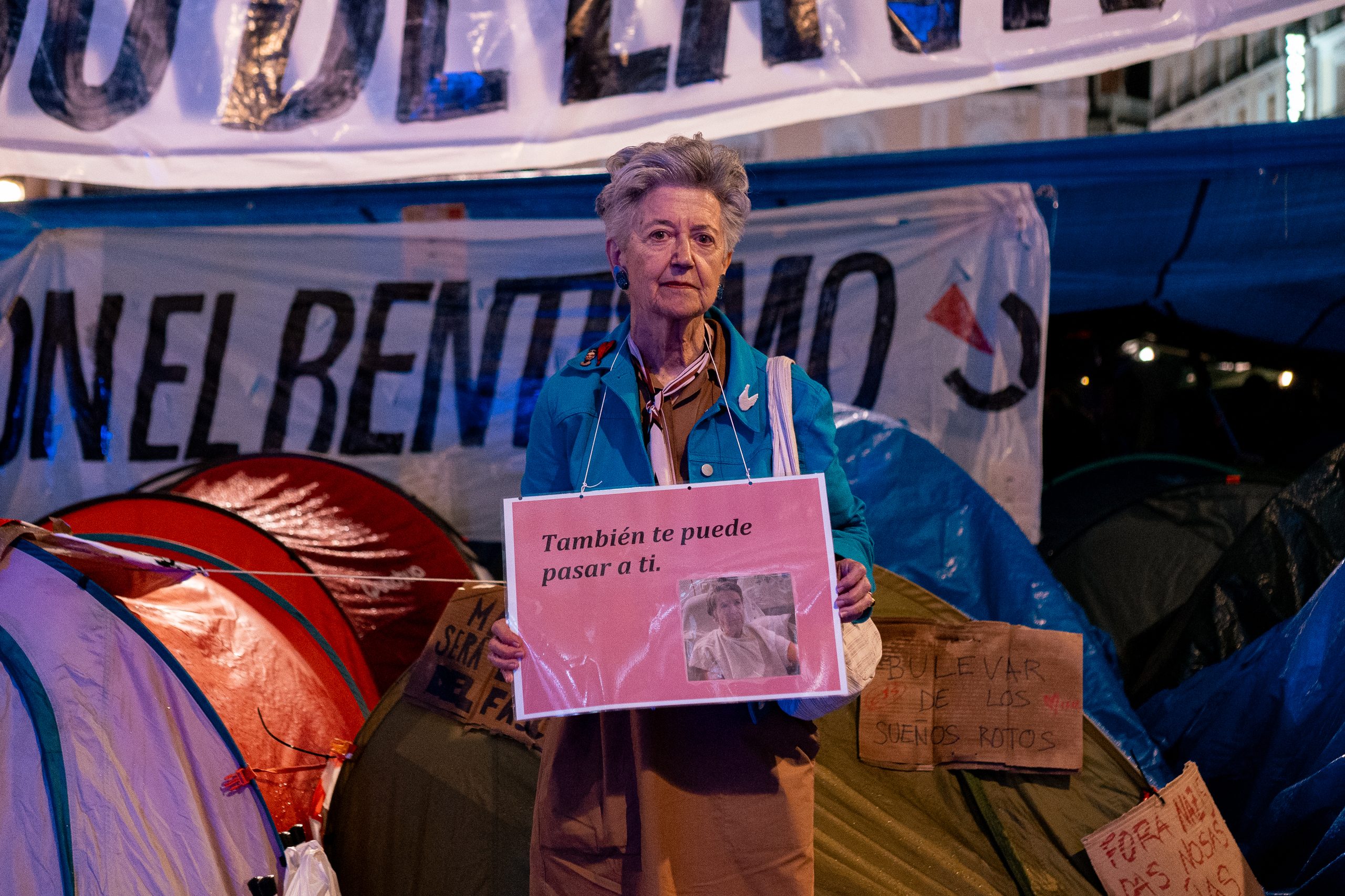
Maricarmen’s eviction became the spark that ignited the discontent that had already been growing over housing prices. On September 26, following a mass demonstration, tenants’ unions and protesters decided to set up a protest camp in Madrid’s central Puerta del Sol. Their main demand was the approval of an emergency decree that, although insufficient to address the root of the problem, would ease the situation by suspending evictions. After three days of political turmoil, the Government presented the decree to Congress, but it failed to secure enough support to pass. Unable to contain the growing public anger, the Government decided to dissolve Parliament and call snap elections for November 29.
The protest camp has achieved a bittersweet victory. On the one hand, it has shaken a political establishment that had appeared largely detached from and inactive in the face of Spain’s housing crisis. On the other, although the elections are a direct consequence of the protests, they have brought down the centre-left government and opened the door to what most opinion polls indicate could be a future victory for the far-right bloc. The parties in that bloc have already said that, if they win the election, their housing policies will focus on protecting property owners: faster evictions, lower taxes and weaker protections for tenants in rental agreements.

Alicia del Río, spokesperson for the Madrid Tenants’ Union, said: “We will not stop until housing is a right,” and reiterated that the protest camp and demonstrations would continue “whoever is in government.”
The story of Maricarmen may have unfolded in Madrid, but the forces behind it are not unfamiliar to those living in Switzerland. As rents continue to rise across major cities and a large share of the housing stock remains in private hands, tenants are increasingly exposed to decisions made by landlords and investment companies whose only interest is financial return. When more tan 70% of the people living in Zurich are renters, the experience of seeing a home treated as an asset rather than a place to live raises a question that reaches far beyond Spain: how much protection do tenants have when the value of their homes is determined by those who own them?
Maricarmen’s story is no longer simply the story of a woman who lost her home. Her case has become a symbol of a crisis affecting millions, putting the right to decent housing against the financial interests of investment funds. As protesters continue to demand solutions and the political debate turns towards the upcoming election, the question remains the same: who will be able to afford to live in our neighbourhoods in the years to come?